
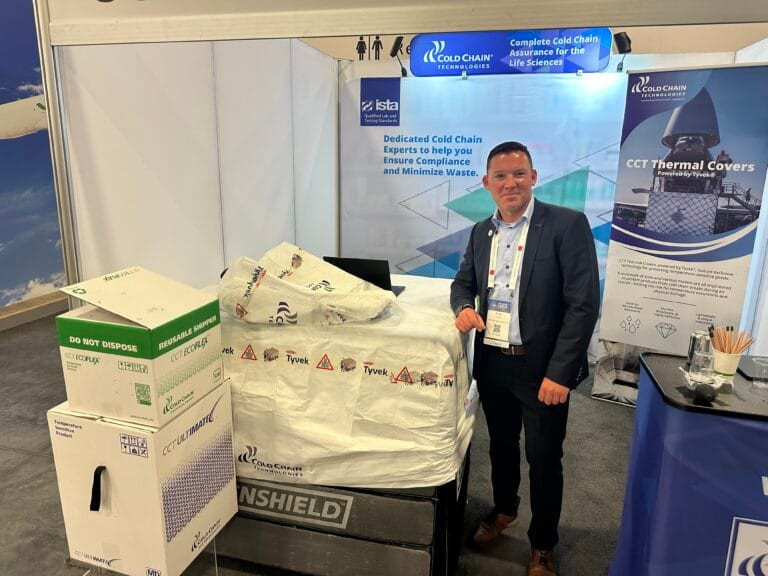
- The cold chain sector is adapting to shifting trade flows, rising pharma demand, and tariffs by expanding geographically (e.g., India) and prioritising agile, specialised operations for high-value shipments like personalised medicine and vaccines.
- Digitalisation and predictive analytics are central, with platforms enabling real-time monitoring, climate-adaptive packaging, and independent temperature control, while sustainability efforts focus on reusable materials and CO₂ reduction.
- Collaboration with airlines, freight forwarders, life science partners, and regulatory bodies is essential to maintain operational resilience, compliance, and service quality amid global constraints and complex therapy requirements.
The cold chain sector is responding to shifting trade flows and rising demand for digitally integrated solutions. Trade dynamics, including tariffs affecting Asian exports to Europe, are reshaping supply chains. Companies are seeking more agile operations to mitigate risk and optimise market presence.
“With the dynamics, the market dynamics that are currently playing, shifting volume from Asia into Europe as a result of the tariffs…we are now having boots on the ground in India, where there is a lot of growth happening on the pharma space,” Kristof De Smedt, Global Market Segment Director Airlines and Logistics Providers at Cold Chain Technologies, said.
Alongside geographic expansion, digitalisation is a key strategic focus for CCT. Cold chain operators are integrating track-and-trace, monitoring, and predictive analytics into packaging solutions to support high-value, high-risk shipments, particularly for personalised medicine and cell and gene therapies. “We are offering our clients with a platform – called CCT Smart Solutions – that helps customers in the pharma space to predict how the packaging is going to behave according to climatological conditions on a global scale,” he added.
The push for more sustainable packagingsolutions is influencing operational choices, although adoption remains region-dependent. Regulatory pressures, including the European 2030 Directive, are steering companies toward recycled materials, while infrastructure limitations in emerging markets sustain demand for single-use solutions. “Although there might be an interest to go for a reusable solution…there is lack of infrastructure,” De Smedt noted.
Complex modalities drive specialisation
Advances in pharmaceuticals, particularly in ultra-low temperature and cryogenic transport, are reshaping cold chain operations. Increasingly complex therapies, such as cell and gene treatments, demand specialised packaging, temperature control, and logistics coordination. Companies are adopting segmented operational structures to manage these requirements, assigning dedicated teams to patient-centric medicines, airline logistics, and reusable packaging strategies.
CCT has emphasised a market segmentation approach to deliver tailored solutions. “There is a team that is focused heavily on patient centric medication. There is a team that is going to focus more on the airline logistics industry because of reusable solutions,” De Smedt said.
Collaboration with airlines, freight forwarders, and life science partners is becoming essential in maintaining service quality amid global constraints. Airfreight capacity limitations, fuel inflation, port congestion, and geopolitical disruptions present operational hurdles. “Collaborating with that industry is going to help us to address these challenges…we partner with industry stakeholders that can help us to address the…needs,” he added.
High-value shipments, such as vaccines and personalised therapies, are increasingly dependent on digital monitoring and independent container operation. Containers that maintain temperature control without continuous recharging provide a layer of risk mitigation. “Our tower Elite…is capable to monitor UK, US, euros as in the same container…connected to our digital platform,” De Smedt explained.
Specialisation extends to sustainability as well. Engineering teams are assessing materials to reduce CO2 emissions without compromising operational reliability, responding to both customer demand and evolving regulatory frameworks. “We have an engineering team that is constantly evaluating what types of new installation materials are there to help reduce CO2 emissions,” he noted.
Regulatory engagement and market outlook
Industry bodies and regulatory associations play a pivotal role in shaping cold chain product development. Companies engage proactively to ensure compliance and longevity of solutions in a rapidly evolving regulatory landscape. Standards for temperature-controlled packaging, sustainability, and digital monitoring are closely monitored to maintain operational readiness and competitive advantage.
CCT collaborates with associations such as the International Safe Transit Association (ISTA) Pharma Commitee to stay ahead of technical and sustainability trends. “We have been collaborating with associations…helping us to work on more sustainable materials, because that regulation is constantly evolving,” De Smedt said.
Emerging demand is concentrated in the personalised medicine sector, particularly cell and gene therapies, as well as in vaccine distribution requiring conventional temperature control. Companies are simultaneously focused on achieving CO2 emission reduction targets by transitioning to more reusable solutions. “There is a lot of push to reduce CO2 emission. We are putting more reusable solutions, going away from single use packaging solutions,” he explained.
The dual pressures of regulatory compliance and operational innovation highlight the need for flexible, market-responsive strategies. Products must balance durability, digital integration, and sustainability, while aligning with the long development cycles of pharmaceutical validation. Companies that can navigate these complexities are positioned to meet growing demand and emerging challenges in the cold chain sector.
The cold chain market will continue to evolve under the combined pressures of global trade shifts, complex therapy requirements, and regulatory mandates. Operators are expected to invest further in regional expansion, digital predictive analytics, and sustainable packaging, while leveraging partnerships across airlines, freight forwarders, and life science companies to maintain resilience and service quality. “By focusing and helping [clients] to identify the right solution that is currently available in our portfolio, that is where we are focused on and following the trends in the market,” De Smedt concluded.