
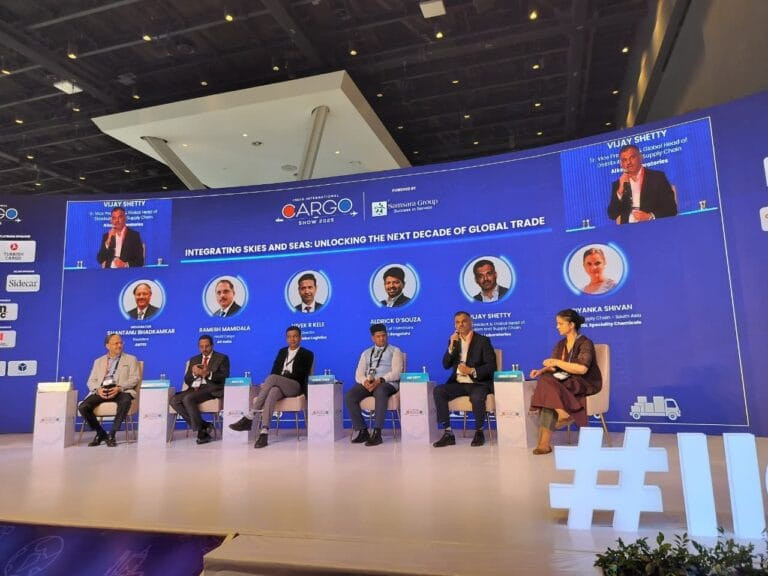
- Global supply chains are shifting from single-mode transport to hybrid air–ocean networks that balance cost, speed and resilience amid geopolitical volatility and manufacturing regionalisation.
- Digital interoperability is emerging as the critical enabler of multimodal logistics, providing the real-time visibility and data continuity needed for seamless transitions between modes.
- Pharmaceuticals, chemicals and other high-value sectors are accelerating the adoption of hybrid routing, driving demand for compliant, predictive and fully integrated transport networks.
Global trade is undergoing a structural reorientation as companies move away from single-mode transport strategies and instead adopt hybrid networks that integrate the strengths of both air and ocean logistics. With supply chains increasingly exposed to geopolitical volatility, manufacturing regionalisation and fluctuating transport capacity, the emphasis is shifting towards multimodal resilience. Hybrid air–ocean systems, underpinned by digital interoperability, are emerging as essential tools for businesses seeking greater predictability and a more balanced approach to cost, speed and reliability.
Across the logistics sector, a clear departure from mode-specific thinking is underway. The focus is now on designing transport networks capable of transitioning seamlessly between modes, supported by digital platforms that enable real-time visibility and coordinated decision-making across stakeholders.
Air cargo’s strategic role in multimodal resilience
Air carriers, traditionally viewed as premium-service providers, are increasingly positioning themselves as core components of integrated supply chains. According to Ramesh Mamidala, Head of Cargo at Air India, customers are reframing how they evaluate logistics solutions.
“Shippers are no longer thinking in terms of air versus ocean; they are thinking in terms of outcomes. Speed, reliability and visibility must coexist, and that requires deeper cooperation across modes.”
Mamidala highlighted that the ongoing shift in manufacturing from China-centric supply chains to multi-country regional networks has amplified the value of air transport as a stabilising mechanism. When cargo owners adjust production or contingency routes at short notice, airfreight acts as a pressure valve that restores timelines, complements ocean capacity and mitigates disruption.
Hybrid models redefining trade-flow planning
The freight-forwarding community is experiencing an accelerated transition towards multimodal planning as businesses rethink how their transport networks are designed. Vivek R. Kele, Director at Teamglobal Logistics, emphasised that hybrid routing models now form part of standard operational strategy rather than being deployed solely for contingency.
“Trade lanes are being redesigned around a balance of cost, risk and responsiveness. Hybrid air–ocean planning allows supply chains to adjust to geopolitical constraints, congestion patterns and customer expectations without compromising service levels.”
Owing to the growing relevance of sea–air and air–sea corridors, particularly through hubs in the Middle East and Southeast Asia, shippers are increasingly adopting hybrid routings that shorten transit times while avoiding the higher costs associated with pure airfreight. These corridors are now supported by digital tools that coordinate modal transitions with greater accuracy and predictability.
Digital interoperability as the foundation of integration
A consistent theme across the discussion was that the effectiveness of multimodal logistics depends on digital continuity. Aldrick Dsouza, Head of Operations at WFS Bengaluru, underscored that physical integration cannot advance without digital alignment.
“You cannot integrate physical networks without integrating digital networks. True multimodality depends on data continuity—consistent, real-time information that moves with the cargo irrespective of the mode.”
Dsouza further noted that ground handlers and terminal operators face heightened expectations for visibility, exception management and data-driven coordination. As digital standards evolve, and as systems such as ONE Record gain momentum, multimodal planning will increasingly rely on interoperable data frameworks capable of supporting predictive analytics and automated workflows.
Sector-specific pressures accelerating hybrid adoption
High-value and regulated industries are at the forefront of multimodal transformation. Vijay Shetty, Senior Vice President & Global Head of Distribution and Supply Chain at Alkem Laboratories, stressed that pharmaceuticals require absolute certainty throughout the logistics chain.
“For a sector like pharma, the question is not air or ocean; it is how to achieve validated, compliant and predictable movement across modes. Hybrid logistics becomes essential when disruptions can compromise product integrity.”
Pharmaceutical supply chains depend on redundancy, contingency routing and temperature-controlled precision—areas where multimodal options expand operational flexibility without breaching compliance requirements.
From the chemicals perspective, Priyanka Shivan, Head of Supply Chain, South Asia at Clariant IGL Speciality Chemicals, emphasised that multimodal decision-making is inseparable from digital accuracy.
“Chemicals require precise coordination and documentation. Digital interoperability is fundamental to safety and compliance.”
As speciality chemical production diversifies across South Asia and the Middle East, multimodal logistics increasingly supports risk management and regulatory conformity, particularly in hazardous-goods segments. Shivan noted that multimodal transport provides flexibility, but only when supported by robust information flows and regulatory alignment.
A shift from mode thinking to network thinking
Throughout the discussion, Shantanu Bhadkamkar, President of AMTOI, highlighted a fundamental shift in logistics strategy, stressing that supply chains must now be engineered for uncertainty rather than built solely for efficiency. He summarised the industry’s evolving priorities through three strategic imperatives:
Intermodal cooperation, not competition, will define resilience in volatile markets.
Digital alignment across air and ocean stakeholders is essential for real-time decision-making and visibility.
Sector-specific logistics requirements, particularly in pharmaceuticals and chemicals, will increase demand for hybrid routing supported by compliant and interoperable systems.
Building the trade networks of the future
Hybrid air–ocean networks are moving into the mainstream of global logistics planning. Advances in digital interoperability, the growth of regional production hubs and the diversification of trade corridors are collectively reshaping how goods will move over the next decade.
As Bhadkamkar observed, the industry is now focused on “building integrated, intelligent and interoperable networks that deliver certainty in a world defined by uncertainty.”
For policymakers, carriers, freight forwarders and global shippers, the implications are significant. The future of global trade will not be determined by individual transport modes, but by the strength of the connections across systems, sectors and geographies that bind them into a cohesive and responsive whole.