

- Airports across the Middle East are expanding runways, terminals, and cargo infrastructure to capture growth in e-commerce, pharmaceuticals, and other high-margin freight sectors. Airlines are investing in freighters, network expansion, and digital systems to align with evolving trade flows.
- iGA Istanbul Airport handled 84.4 million passengers in 2025 and will host Turkish Airlines’ US$2.3 billion cargo terminal, projected to move several million tonnes annually and create 26,000 jobs. Dubai International processed over half a million tonnes of freight in Q1 2025, while Emirates SkyCargo expands its fleet to 21 freighters by 2026, adding new destinations and frequencies. dnata handled more than one million tonnes in Dubai, focusing on automation, data integration, and cross-sector collaboration.
- Saudi and Abu Dhabi airports are also scaling up. Riyadh is building a third runway to increase aircraft movements from 65 to 85 per hour. Saudia Cargo is shifting focus to specialised freight, e-commerce, and sustainable operations, while Abu Dhabi Airports and Etihad Cargo continue network growth and operational enhancements. Hamad International in Doha maintained strong cargo volumes in 2025, with Qatar Airways Cargo supporting time-sensitive global trade under new leadership.
From Istanbul to Abu Dhabi, airports are adding runways, revamping terminals, and ramping up cargo infrastructure. Airlines are chasing growth in high-margin segments like e-commerce and pharma, while doubling down on freighters and reshaping networks to match the new trade reality.
In this report, we look at how the region’s biggest hubs ended 2025 – and what they’re planning for 2026.
IGA İstanbul Airport
Hoş Geldiniz İstanbul
iGA Istanbul Airport closed 2025 with 84.4 million passengers and 549,309 aircraft movements, reinforcing its status as a key global gateway. The hub now connects to over 330 destinations – 309 of them non-stop – through 116 airline partners, making it the most connected airport in Europe for the second consecutive year, according to ACI Europe.
Operationally, iGA remains a standout. As the first European airport to implement triple runway operations, it has reached a movement capacity of 148 per hour. The integration of biometric boarding systems has reduced boarding times by 30 percent, part of a broader digital infrastructure strategy that also includes RFID baggage tracking and AI-powered customer tools.
On the sustainability front, the airport has committed to reaching net zero emissions by 2050. A €212 million investment in the Eskişehir solar power plant will enable iGA to supply 100 percent of its terminal energy from solar. Its renewables target has been raised from 50 to 90 percent by 2030. A climate adaptation plan developed with TÜBİTAK aims to embed long-term resilience into its operations.
Recognition has followed: the airport is one of only six globally to achieve ACI Level 5 Customer Experience accreditation and has been named “Best Airport in the World” by Condé Nast Traveler three times in the past four years.
A US$2.3 billion cargo bet
2,3 Milyar Dolarlık Kargo Yatırımı
Turkish Airlines has announced a US$2.3 billion investment to build what it says will be the world’s largest air cargo terminal at Istanbul Airport, alongside a new in-flight catering facility. The move signals a major expansion of the airline’s logistics infrastructure, as cargo continues to play a central role in its long-term growth strategy.
The terminal is expected to handle several million tonnes of freight annually – well above the carrier’s current volumes, which are already close to 2 million tonnes per year. The catering complex, designed for scalability and improved quality control, will serve Turkish Airlines’ global passenger network, the largest in terms of countries served.
According to the airline, the project will create approximately 26,000 jobs across logistics, ground handling, supply chain, and catering services. Executives have described the development as both a strategic aviation investment and an economic initiative, reinforcing Istanbul’s position as a logistics and passenger hub across Europe, Asia, Africa, and the Middle East.
 Moving through Dubai
التنقل عبر دبي
Dubai International Airport (DXB) processed 517,000 tonnes of freight in the first quarter of 2025 – down 3.6 percent year-on-year, but still a clear indication of its role as a regional cargo stronghold. For Emirates SkyCargo, 2025 demanded that the same leverage be applied with flexibility. “We had to adapt quickly – rerouting shipments, or redeploying capacity, re-thinking strategies and working in close coordination with our customers and partners to keep a steady flow of goods moving,” said Badr Abbas, Divisional Senior Vice President at Emirates SkyCargo.
Emirates SkyCargo enters 2026 with its priorities firmly set: fleet growth, network reach, digital efficiency, and future-fit infrastructure. “In 2025, we built the runway for what comes next,” said Badr Abbas, Divisional Senior Vice President. “We strengthened the core pillars of our business by expanding our network and innovating with our product portfolio and operations.”
By December 2026, Emirates expects to operate a fleet of 21 freighters—up from 11 Boeing 777Fs and 5 wet-leased 747s today—as it takes delivery of up to 10 new 777Fs. The first passenger aircraft has also entered its freighter conversion programme, with entry into service expected next year.
The airline added eight freighter destinations in 2025 – Copenhagen, Narita, Bangkok, Mumbai, Beirut, Conakry, Phnom Penh, and Hanoi – bringing its dedicated cargo network to 42 cities across six continents. Frequencies to core lanes such as Guangzhou, Shanghai, and Johannesburg were also increased, with Hanoi ramped up to four flights per week in response to demand.
Badr Abbas, Divisional Senior Vice President, Emirates SkyCargo, said: “Next year we expect delivery of several Boeing 777 freighters currently on order, with aims to operate a fleet of 21 aircraft by December 2026. This will almost double our current freighter capacity, providing us with the flexibility and resources to expand our network, layer on additional frequencies to high volume lanes and better serve our global customers.”
“As always, our freighter operations are underpinned by our passenger fleet, which we also expect to grow throughout the next year, with further deliveries of our A350 aircraft. As the A350s enable us to reach new, smaller markets, its another way we’re able to serve new destinations with our world-class product and service.”
Reflections on dnata
قراءة في نتائج “دناتا”
dnata closed 2025 having handled over one million tonnes of cargo in Duba.
“2025 stood out as a year when the industry proved its ability to operate confidently amid ongoing change,” said Guillaume Crozier, Chief Cargo Officer at dnata.
The UAE continued to strengthen its position as a preferred global logistics hub, underpinned by multimodal infrastructure and coordination between industry and regulators.
“The UAE, in particular, reinforced its role as a preferred logistics hub, supported by strong connectivity, multimodal infrastructure, and close collaboration between industry and authorities. At dnata, surpassing one million tonnes of cargo handled in Dubai over a twelve-month period reflected that resilience in very practical terms,” Crozier noted.
“We’ve all learned that strong collaboration – between airlines, handlers, customs and airports – pays off when demand shifts,” he said.
Technology also played a larger role in daily operations. At dnata’s Dubai facilities, the deployment of autonomous inventory drones improved warehouse accuracy and allowed staff to focus on higher-value tasks. Tools that increase visibility and decision speed were key to keeping operations smooth.
Looking ahead to 2026, the focus will be on data quality, interoperability, and cross-sector coordination. dnata also sees workforce capability and infrastructure resilience as essential as operations grow more complex. “The greatest opportunity lies in strengthening collaboration across the cargo ecosystem,” Crozier said.
Riyadh’s rise
نهضة الرياض
Riyadh’s airport infrastructure is entering a new phase of development, aimed at boosting capacity and positioning the Saudi capital as a major global hub.
At King Salman International Airport, construction has begun on a third runway, a key part of the airport’s long-term expansion strategy. The 4,200-metre runway is designed to align with prevailing wind conditions and includes multiple access taxiways to support more efficient ground operations. Current capacity stands at around 65 aircraft movements per hour, with the new runway expected to raise that figure to 85 once operational.
The project is being delivered in partnership with FCC Construcción SA and Al-Mabani General Contractors Company, and is central to the airport’s goal of expanding international connectivity across multiple markets.
Meanwhile, King Khalid International Airport – ranked 24th in Skytrax’s 2025 global ranking, up 11 places from last year – is preparing for its most significant operational overhaul since opening over 40 years ago. A strategic transformation plan is set to begin implementation in Q1 2026, involving a major terminal reconfiguration.
 Saudia Cargo’s outlook
الآفاق المستقبلية لـ “السعودية للشحن”
For Saudia Cargo, 2025 marked a structural shift in global supply chains – most notably, a move away from China and a sharp increase in flows to Europe and the Middle East.
These changes, driven by geopolitical factors and tariff strategies, tested the industry’s resilience,” said Abdulelah Altunisi, Chief Financial Officer. “For Saudia Cargo, it validated our strategic investments in network agility and diversified services.”
While overall growth was subdued, specialised cargo segments—particularly e-commerce, pharma and high-tech – proved more stable and profitable. Saudia Cargo reported a 23 percent increase in e-commerce volumes, driven by redirected trade from China to the Middle East and new capacity allocations across high-growth APAC lanes.
Capacity growth outpaced demand, creating downward pressure on rates. IATA forecast 0.6 percent volume growth against 6 percent capacity gains, squeezing margins industry-wide. Carriers with disciplined cost controls and fleet efficiency were better positioned.
Looking ahead, 2026 is expected to be shaped by sustainable capacity management, digitalisation, and deeper specialisation. Altunisi emphasised the need for “superior value beyond speed”—through bespoke solutions and seamless integration. The biggest risk? A modal shift back to ocean freight as reliability improves, combined with volatile fuel prices and continued overcapacity.
Still, Altunisi sees clear upside in e-commerce from South and Southeast Asia, coupled with the company’s fleet expansion and global partnerships under the “Saudia Cargo Global” programme. “2026 will be a year of confident, solution-driven growth,” he said. “Strategic investments in efficiency, specialisation, and diversification will define sustainable value creation.”
Abu Dhabi’s momentum
قوة الزخم في أبوظبي
Abu Dhabi Airports reported continued momentum in Q3 2025, with cargo volumes rising 15.5 percent year-on-year to more than 200,000 tonnes across its five commercial airports. The year-to-date total reached 545,511 tonnes, reinforcing the emirate’s growing relevance as a regional trade and logistics hub.
While much of the attention centred on the group’s 18th consecutive quarter of double-digit passenger growth, cargo also played a central role in its expansion strategy. Zayed International Airport (AUH) handled 49,073 aircraft movements in Q3, up 5.9 percent compared to the same period in 2024, as new routes and airline partners contributed to a broader uplift in activity.
Recent additions to the network include China Eastern Airlines’ daily service to Shanghai, Ethiopian Airlines’ new connection to Addis Ababa, and expanded operations by IndiGo and Air Seychelles. In parallel, Jazeera Airways resumed flights connecting both AUH and Al Ain with Kuwait, further strengthening regional ties.
The third quarter also saw the airport group receive ACI Level 2 Accessibility Accreditation and Level 3 Customer Experience Accreditation, recognising operational improvements and service quality. AUH was also named Best Airport for Retail at the 2025 Frontier Awards.
Speaking on the results, Managing Director and CEO Elena Sorlini described Q3 as “a landmark achievement,” crediting sustained network growth and stronger operational coordination. “Our airports are better positioned than ever to scale the emirate’s rapid advance,” she said.
Etihad Cargo’s position
مكانة “الاتحاد للشحن” في السوق
Etihad Cargo enters 2026 in a strong position, as global airfreight demand continues to outpace capacity. Between January and August 2025, international air trade grew 8.5 percent year-on-year, driven largely by surging low-value e-commerce flows.
China–Europe lanes now account for an estimated 40 percent of e-commerce volumes, while over half of China–U.S. air cargo was tied to e-commerce demand.
That same period saw China–U.S. airfreight fall by nearly 20 percent, reshaped by tariff pressures and shifting sourcing strategies. Imports from Taiwan and Vietnam almost doubled, while India surpassed China as the largest supplier of smartphones by air—a structural change expected to carry into 2026. These shifts are keeping Asia–Middle East–Europe corridors busy and yields elevated.
Against this backdrop, Etihad Cargo delivered “consistently strong results” through 2025, according to Andy Newbold, Global Head of Commercial. “With a clear focus on customer performance, service quality, and innovative proposition, the company is well-positioned for another strong year as global capacity remains constrained in 2026,” he said.
Despite healthy long-term fleet planning, the near-term supply picture remains tight. International cargo capacity has seen little meaningful growth since 2019, and freighter availability is still heavily concentrated among integrators. Etihad holds one of the largest future freighter order books among Middle East carriers, but most deliveries will come post-2026, meaning supply pressure will persist in the short term.
 Demand in Doha
تنامي الطلب في الدوحة
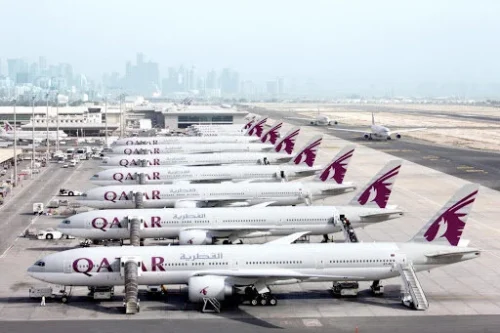
Qatar’s air cargo sector maintained its strength through the second half of 2025, supported by Hamad International Airport and the country’s integrated logistics infrastructure. In Q3 2025, the airport handled 664,975 tonnes of cargo, a marginal 0.8 percent year-on-year decline, despite wider trade disruptions. Passenger traffic rose 4.3 percent to 14.3 million, while aircraft movements were up 1.3 percent, totalling 72,700.
In December, Qatar’s General Authority of Customs reported 568,658 tonnes of air cargo handled nationwide. Strong customs activity across air, land and sea ports further reflected continued trade momentum, with over 600,000 declarations processed during the month.
Qatar Airways Cargo continues to support the movement of high-value and time-sensitive goods between major global markets. Its performance is closely tied to Hamad International Airport, which remains a key logistics hub in the region.
Leadership transition also marked the end of the year, with Hamad Ali Al-Khater appointed as Group Chief Executive Officer of Qatar Airways Group, effective 7 December 2025. Al-Khater previously served as Chief Operating Officer at Hamad International Airport, where he oversaw operational reliability, strategic development, and infrastructure expansion.