
Volumes and yields predicted to grow in 2017

Volumes and yields predicted to grow in 2017

2016 has been a year of two halves, with a tough first half, but improvements in the second, Cathay Pacific general manager cargo sales & marketing, Mark Sutch (pictured below) tells Air Cargo Week staff writer, James Muir.

Last year had an exceptional start, helped by the US West coast seaport disruption before tapering off while 2016 started off slowly, both in terms of tonnage and yield, then picking up in the second half.

Sutch comments: “It’s not unusual in airfreight (particularly when based in Asia Pacific) to have a year of two halves and this has been very much the case.”

September to December has been strong, but the transpacific market is slowing in the run up to Christmas, though Sutch says Westbound out of Hong Kong is expected to remain strong up to Christmas itself, giving him confidence that 2017 will start well.

He tells ACW: “I am confident that 2017 will start on a significantly strong footing than 2016. Both yield and tonnage will grow – yield considerably.”

HKG0 20121022 HONG KONG, HONG KONG : Terry Lo, CEO of GLS and of Cathay Pacific Airways, shown in Hong Kong on Monday, 22 October, 2012.


Something else to look forward to next year is Cathay Pacific’s joint business agreement with Lufthansa Cargo, which is due to go live on 1 February 2017. Lufthansa has already moved to the Cathay Pacific Cargo Terminal, which Sutch says has been very smooth and forwarders now have a single pick-up and drop-off area for services.

Sutch says: “CX/LH will offer a seamless metal neutral product to the market. We believe this will bring customer efficiencies in HKG/ FRA and other points between HKG & Europe.”

The biggest benefits for customers, Sutch says include a single point of handling in both Frankfurt and Hong Kong, a greater choice of flights, a joint pool of capacity and a greater spread of flights across the week.

Nearer to home, Sutch says Cathay Pacific has a very extensive network across Asia Pacific and much of the future growth will come from passenger aircraft with the arrival of Airbus A350s.

He also says: “We shall continue to look for new freighter opportunities as we have recently done with launching new ports of Portland and Wellcamp Brisbane West.”

Hong Kong – North America remains Cathay Pacific’s busiest trade lane, followed by Hong Kong – Europe, with India proving to be a strong market in recent years.
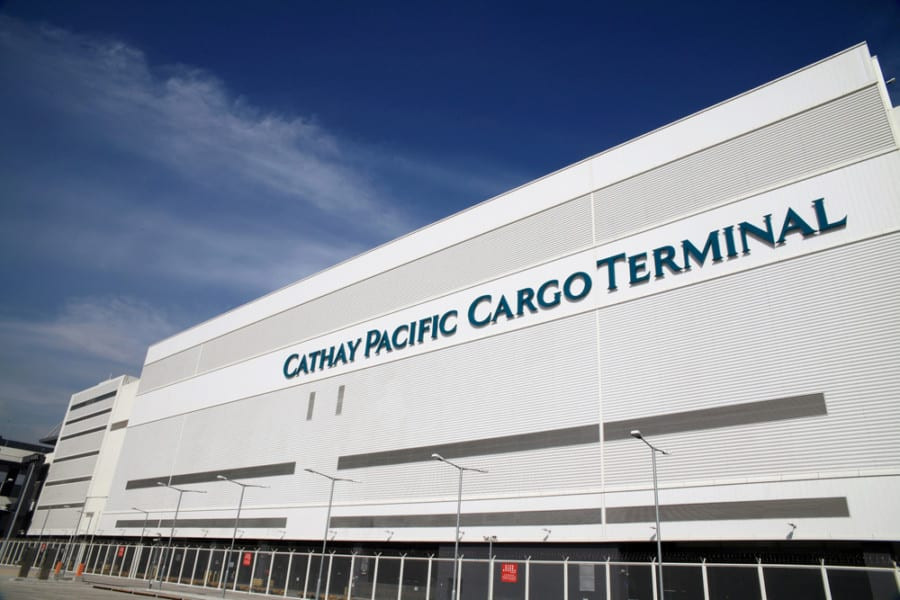
Cathay Pacific Cargo Terminal

Sutch tells ACW: “IntraAsia is a growing market and given the number of widebody passenger services we offer we have room to grow in this key sector.”

He believes the growing domestic markets in China and India, and the development of South East Asia will provide a base for air cargo to grow in the future.

Sutch says: “At CX we believe in operational excellence, handling efficiency, network and frequency spread and a combination between freighter capacity and belly.”

Across the network, electronic consumer goods have remained popular from Asia to North America and Europe, while
mail driven by e-commerce and perishables have registered strong growth. Sutch says perishable demand is coming from China with good growth from North America, Australia and Europe.

Outsized cargo is also performing well, with ExpertLift product. Sutch comments: “Although hard to predict this market it has been strong in recent months and we expect our expertise in this area will set us well for future growth on 2017.”


Picture of James Graham

James Graham

James Graham is an award-winning transport media journalist with a long background in the commercial freight sector, including commercial aviation and the aviation supply chain. He was the initial Air Cargo Week journalist and retuned later for a stint as editor. He continues his association as editor of the monthly supplements. He has reported for the newspaper from global locations as well as the UK.

subscribe to acw for free
stay informed. stay ahead

To get the latest air cargo news and industry trends delivered directly to your inbox, subscribe now!

Newsletter

Stay informed. Stay ahead. To get the latest air cargo news and industry trends delivered directly to your inbox, sign up now!

related articles

How Brazil’s gateway is repositioning itself as the Americas’ southern logistics anchor

Air travel in Southeast Asia is growing at a rate well above the global average. This has prompted the development of a new airport to serve as Cambodia’s new capital gateway. Cambodia has responded with Techo International Airport (KTI) – a landmark project by Cambodia Airport Investment Co. Ltd. (CAIC), a subsidiary of Overseas Cambodian Investment Corporation, in partnership with the State Secretariat of Civil Aviation (SSCA) – bringing world-class infrastructure and next-generation airport systems to the country’s new capital gateway. Replacing the former Phnom Penh International Airport, Techo International Airport opened on 9 September 2025 and represents the centrepiece of Cambodia’s aviation strategy. The airport is classified as a “4F-class” airport – meaning it can accommodate the largest cargo and passenger aircraft, such as Airbus A380 and Boeing 747, which allows large-scale cargo operations. According to plans, in its first phase the airport is expected to handle up to 175,000 tonnes of air cargo per year. Early official data cited indicates that the airport is designed for around 26,000 tonnes of cargo annually under initial operations. The large cargo-handling capacity (175,000 t/year) is significantly higher than the early-operation figure (26,000 t/year), which suggests the airport will scale up cargo operations as traffic increases. The airport’s infrastructure (runway, terminals, large-aircraft capability) positions it to support major international freight, enabling imports and exports of goods such as garments, agricultural products, electronics, helping Cambodia increase trade volumes. With large-aircraft handling, Techo can link to long-haul cargo routes around the world. Operational cargo logistics at Techo The airport now has a dedicated cargo terminal. Working hours for cargo operations are listed as 08:00 to 00:00 (midnight), seven days a week, though with flexibility depending on flight schedules. Customs operations are generally Monday–Friday 07:00–17:30 (with Saturday half-day), but clearance outside those hours can be arranged by prior coordination. As the airport has just opened, the full ramp-up of freight may take time. So the cargo-handling capability, a maximum of 175,000 tonnes a year, is a target rather than yet-achieved throughput. To give a scale of the planned operation, Cambodia’s three international airports collectively carried 75,000 tonnes of air cargo in the first 10 months of 2025.

Airfreight’s evolution: Improvisation to ambitious systemisation