
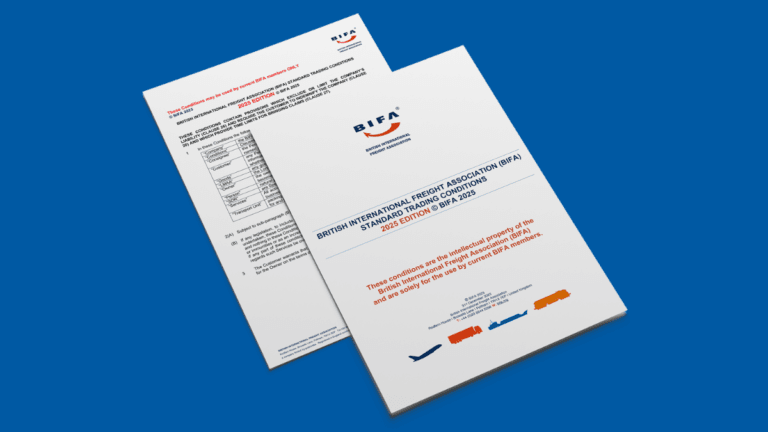
- The BIFA Standard Trading Conditions 2025 Edition came into full legal effect on 1st January 2026, and any freight forwarder that has not incorporated them into client contracts is now operating without enforceable legal protection against claims.
- The updated STC reflect post-Brexit and digital trade realities, strengthening provisions on customs authority, dangerous goods liability, shared loads, lien and disposal rights, claims time limits, and customer compliance obligations across a single UK-wide framework.
- Forwarders that missed the deadline must urgently update contracts, notify clients and insurers, train staff, and secure written customer acceptance, as failure to do so leaves them exposed to significant liability risks, particularly in airfreight and high-value or regulated cargo.
Missing the 1st January 2026 deadline that just passed is not just an administrative oversight – it could leave forwarders exposed to claims with no enforceable legal protection. In an industry where disputes over liability are common, that’s a critical gap.
As of 1st January 2026, the new British International Freight Association (BIFA) Standard Trading Conditions (STC) 2025 Edition are in full legal effect – and any freight forwarder that has not yet incorporated them into client contracts is now operating without protection.
The updated STC replace the 2021 version and reflect fundamental shifts in customs operations, liability, and freight risk, particularly in a post-Brexit, digitally driven market where legal clarity and contractual robustness are more critical than ever.
Unveiled in September, the revised STC have been developed in response to significant changes in the UK’s trading environment, including a marked increase in customs-related activity. Ongoing turbulence in global trade has also heightened the level of risk faced by BIFA’s corporate members in the conduct of their business.
What’s at stake?
According to BIFA, members who fail to effectively incorporate the new terms into their contractual frameworks risk having no enforceable protections. In practical terms, this means a freight forwarder could face claims for loss, damage, delay, or misdeclaration without the safety net the STC are designed to provide.
In today’s operating landscape, this risk is far from theoretical. The growing complexity of multimodal operations, customs compliance, dangerous goods, and groupage consignments means freight forwarders are being held to higher standards by both clients and regulators.
“Failing to implement an effective incorporation process will leave BIFA members unprotected against potential claims,” warned BIFA Director General Steve Parker ahead of the deadline.
What’s changed?
The 2025 STC update how risk, responsibility, and representation are shared between the forwarder and the customer.
Key changes include:
• Customs authority clarified: BIFA members are assumed to act as direct customs agents unless legally restricted. They are also explicitly permitted to appoint sub-agents.
• Stronger lien and disposal rights: Forwarders can now sell or dispose of goods with just seven days’ notice, or immediately if storage costs outweigh resale value, regardless of the goods’ location.
• Shared load protections: Members are given the explicit right to remove or deal with problematic items in shared loads to avoid delays to other cargo.
• Dangerous goods responsibilities: Customers are liable not only for their own declarations, but also for the actions of any third parties, such as packers, acting on their behalf.
• New customs compliance obligations: Customers are now accountable for:
– Supplying correct customs codes
– Complying with Postponed VAT Accounting
– Providing accurate valuations and commercial documentation
– Adhering to sanctions and export control requirements
• Claims time limits: Legal claims must now be filed within nine months from delivery, or attempted delivery, with a possible six-month extension where the claimant lacked knowledge of the cause of action.
• One UK-wide edition: The previous separate STC for Scotland and Northern Ireland have been consolidated into a single UK-wide version governed by English law. Courts in Scotland and Northern Ireland remain competent to hear disputes where either party is based in those jurisdictions.
Missed the deadline? Here’s what you must do now
For any freight forwarder that has not yet formally adopted the new STC into its contracts, the following actions are urgent and non-negotiable:
• Inform clients and insurers about the changes to the STC.
• Train staff, particularly those in customer-facing and operational roles, on what is new and what has changed.
• Update all contracts and documentation to reference the 2025 edition of the STC.
• Secure written agreement from customers, ideally during onboarding or credit set-up, to avoid later disputes over which terms apply.
Missing the deadline means freight forwarders may now face claims without the legal protection the STC are designed to provide. Without properly incorporating the 2025 edition of the STC into contracts, forwarders may find themselves exposed to claims with no contractual safety net.
For airfreight forwarders, the risks are even more pronounced. The carriage of lithium batteries, high-value perishables, and e-commerce fulfilment demands precision, and the consequences are significant when goods are damaged, delayed, or misdeclared.
The revised STC support forwarders by reinforcing clear contractual limits on liability, customer obligations, and timelines for claims, but only where those terms are properly incorporated into the contract.