
- In 2025, air cargo growth shifted toward emerging markets, with Africa and other Global South corridors seeing rapid expansion, while major lanes remained stable but less dominant.
- Carriers faced challenges from US-driven trade volatility, tariffs, de minimis changes, and limited aircraft availability, making operational planning and scaling more complex despite rising demand.
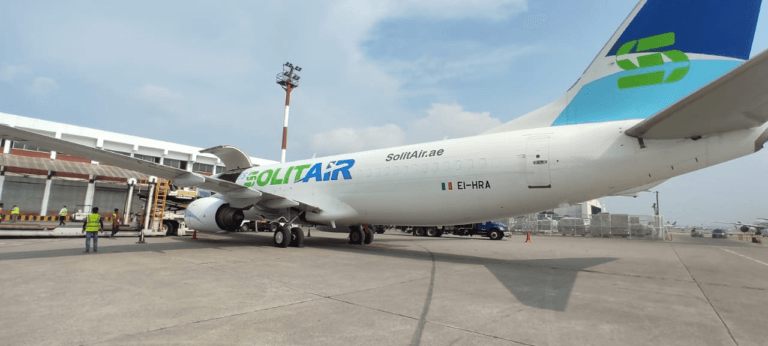
- E-commerce and underserved routes drove opportunities, with airlines like SolitAir and Astral Aviation focusing on high-frequency, reliable services in fast-growing regions to capture unmet demand.
Air cargo did not leave turbulence in 2025 — it just altered form. Demand continued to rise, but the industry’s centre of gravity shifted, with Africa and other Global South corridors beginning to take more weight. Meanwhile, geopolitics, trade regulations and aircraft availability forced carriers to rethink the source of growth — and how to deliver it reliably.
Two carriers with deep African exposure, SolitAir and Astral Aviation, describe the same year through different lenses: one focused on building new lanes into underserved markets, the other on recalibrating networks amid US-driven trade volatility. Together, their comments sketch a region gaining relevance just as the operating environment becomes harder to predict.
For Hamdi Osman, Founder and CEO of SolitAir, 2025 was about getting airborne and moving fast into routes legacy networks often treated as secondary.
“For SolitAir and the wider airfreight sector, 2025 has been a defining year. Securing our Air Operator Certificate (AOC) from the UAE General Civil Aviation Authority (GCAA) was the pivotal moment – it enabled us to launch operations and quickly establish a network across more than 35 Global-South routes, including eight destinations across Africa in our first year,” he said.
“From our perspective, the airfreight industry in 2025 has evolved through a clear shift toward emerging and underserved markets, where demand is expanding fastest. Regions such as Africa are now among the most rapidly growing cargo markets globally, while major trade lanes like Europe–Asia and intra-Asia continue to strengthen.”
SolitAir points to the same data many carriers have been watching closely — Africa outgrowing the global average.
“Across the global airfreight industry, 2025 has been characterised by a steady and broad-based recovery, with global air cargo demand up 2.9 percent year-on-year in September 2025 and capacity rising 3 percent. African carriers led with 14.7 percent demand growth, reflecting shifting trade patterns and rising demand in emerging markets.”
That growth, Osman argues, reflects a rebalancing of flows — away from the handful of mega-lanes that once defined cargo strategy.
“This rebalancing of global cargo flows aligns closely with SolitAir’s focus on Global-South connectivity.”
Astral Aviation’s CEO Sanjeev Gadhia describes 2025 less as a recovery story and more as a year shaped by policy shocks.
“In my opinion, the defining moment of 2025 was the volatility caused by the US tariff changes and tightening of the de minimis rules, which affected the airfreight industry.”
For operators touching e-commerce-heavy lanes, that combination matters: tariffs change landed-cost maths, while de minimis tightening hits the economics of low-value, high-volume cross-border parcels. Gadhia’s takeaway is blunt.
“The evolution from volatility to recalibration has resulted in stability for a number of cargo airlines.” He also points to geopolitics as the persistent disruptor behind network decision-making.
Osman’s view of the challenge is more operational than policy-driven, but it lands in the same place: planning is harder, and scaling has to be controlled.
“The biggest challenge in 2025 has been scaling operations responsibly amid shifting demand, evolving trade patterns and tight aircraft availability.”
Even when demand is there, lift is not always easy to secure.
“Airlines are operating in a market where capacity is rising slightly faster than demand, and sourcing the right aircraft – both dedicated freighters and P2F conversions – remains difficult.”
e-commerce continues to underpin growth, particularly where airport infrastructure and trucking networks are uneven, and air becomes the fastest bridge.
“The standout opportunity in 2025 has been the ability to serve high-growth and underserved trade corridors, particularly in the Global South. With Africa showing strong YoY cargo demand growth, there is clear unmet demand for reliable, high-frequency airfreight services,” mentioned Osman.