
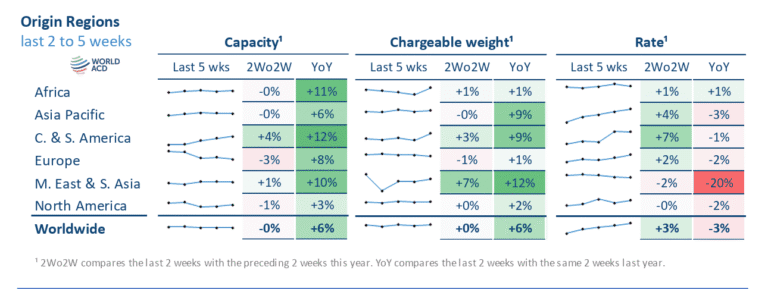
• Air cargo spot rates from Asia Pacific continued rising ahead of Black Friday, increasing by four percent week on week to 4.11 US dollars per kilo.
• Rates to the United States reached 5.51 US dollars per kilo, supported by strong demand from Japan, South Korea, and Vietnam, although year-on-year levels remain lower.
• Southeast Asia is driving the strongest year-on-year growth, with tonnages to the United States up by forty percent in October, reflecting shifting supply chains and high demand for semiconductors.
Air cargo rates have continued to rise in the lead-up to Black Friday and Thanksgiving, driven by further increases in spot prices from Asia Pacific to the United States and Europe, according to the latest figures from WorldACD Market Data. Intra-Asia tonnages and rates have also increased.
The report covers developments across the last five weeks up to Sunday, 16 November 2025.
Average spot rates from Asia Pacific origins rose by four percent week on week to 4.11 US dollars per kilo in the second full week of November (week 46: 10–16 November). Tonnages from the region also increased by one percent during this key retail period.
Spot rates from Asia Pacific to the United States rose by a further four percent week on week to 5.51 US dollars per kilo. This was driven by a sharp recovery from Japan, where tonnages increased by sixteen percent and spot prices by ten percent following the national holiday the previous week. South Korea recorded a thirteen percent gain, and Vietnam an eight percent rise. However, average spot rates from Asia Pacific to the United States remain eleven percent lower year on year, with the largest decreases seen from Japan (thirty-one percent), Singapore (nineteen percent), Indonesia (nineteen percent), Vietnam (seventeen percent), South Korea (ten percent), and Hong Kong (eight percent).
As highlighted last week, Asia Pacific exports to both the United States and Europe in late 2024 experienced exceptionally strong demand and severe capacity constraints, particularly from China, due to surging e-commerce volumes. This means current year-on-year comparisons are challenging, even though rates remain relatively high by historical standards.
Air cargo tonnages from Asia Pacific to the United States remain significantly higher year on year despite the introduction of higher tariffs and de minimis restrictions on US imports from China and other markets since April. Although tonnages from China (down two percent year on year), Hong Kong (down sixteen percent), and South Korea (down ten percent) were below last year’s levels in week 46, the region overall recorded a six percent year-on-year increase.
Strong growth from Southeast Asia to the United States
Tonnages from Taiwan and Southeast Asia have driven most of the region’s year-on-year growth to the United States in recent months. According to new WorldACD analysis, demand from Southeast Asia to the United States rose by forty percent year on year in October, the highest full-month growth figure of the year. For the first ten months of 2025, tonnages from Southeast Asia to the United States were up by nearly twenty-six percent on average.
In contrast, year-to-date tonnages from China and Hong Kong to the United States were down by almost six percent year on year, although exports to Europe rose by around eight percent. Year-to-date tonnages from Southeast Asia to Europe fell by almost six percent.
These patterns reflect a broader shift as US importers diversify sourcing away from China. For countries such as Taiwan, they also highlight exceptionally strong demand for high-performance semiconductor chips, including those used in artificial intelligence. Air imports from Taiwan have consistently risen by thirty to fifty percent this year, with similar year-on-year increases from Vietnam, Thailand, and Malaysia, all major exporters of semiconductors and electronic components. In week 46 alone, tonnages to the United States from Taiwan, Vietnam, Thailand, and Malaysia were up by forty-one percent, sixty percent, thirty-seven percent, and sixty-two percent respectively.