
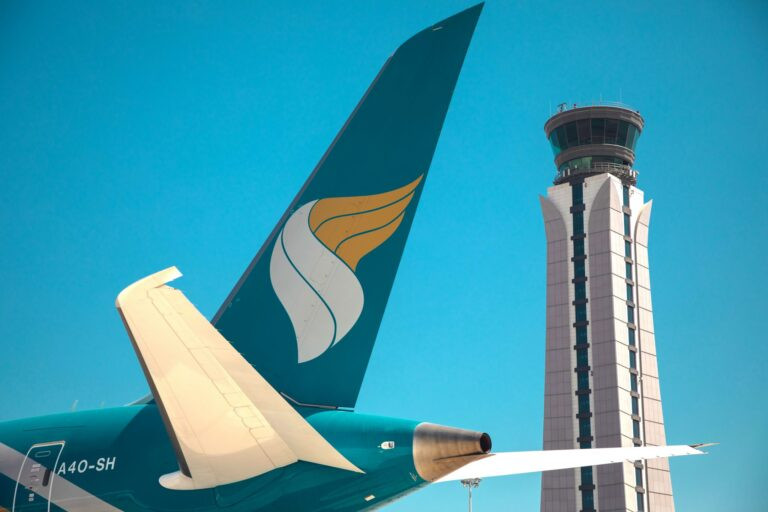
- Oman Air is reshaping its cargo strategy to focus on high-yield flows, optimising belly capacity, and selectively deploying freighters to support long-term sustainability while maintaining flexibility for growth in e-commerce and other targeted markets
- Muscat serves as a key transit hub, with cargo operations primarily transit-driven, requiring careful management of turnaround times, temperature-sensitive shipments, and specialised handling to maximise facility utilisation
- The airline is strengthening customer engagement and regional sales capabilities, targeting pharmaceuticals, perishables, and other high-yield cargo, while leveraging reliability, agility, and close client relationships to differentiate itself in a competitive regional market
Oman Air is reshaping its cargo strategy around targeted deployment of capacity and a tighter focus on high-yield flows, reflecting broader regional shifts in airfreight demand and network economics. Prioritising optimisation of existing belly space, selective freighter deployment, and a recalibrated operational model built on scale discipline, the carrier is aiming to support long-term sustainability while preserving room for renewed growth when market conditions permit.
“We still have to make money. We still have to produce the goods. But it is more of an overall airline mindset that is just a recorrection of where we have been and where we have to be now in order to sustain and make it long term,” Mike Duggan, Head of Cargo at Oman Air, said. “It is about right-sizing, getting ourselves in the right shape, so that we are in a position to grow effectively. We are looking at products, looking at how we can get yields up, and talking to different customers and segments.
“Our freight strategy is all about optimising and making the best use of our belly capacity. The passenger network is set by passenger demand and therefore does not often quite meet the total needs of the market. We look at where we can take the freighters to supplement that, increase yields, get cargo that we could not otherwise carry.”
The airline’s narrow-body fleet shapes additional operational considerations. “We have a significant narrow-body passenger fleet, and they are all bulk holds only. The freighters also put us in markets that we are not able to be in otherwise. It is a bit of a tandem. One serves the other,” he said.
Freighter expansion remains a future option rather than a near-term commitment. Planning is already tied to e-commerce flows between Asia, the Middle East, and Europe. “We are looking at putting some wide-body capacity into the Hong Kong slash China to Europe market through Muscat,” he said. “There is already an established e-commerce thing going on, and we are already carrying a lot of that cargo. Hopefully this Hong Kong freighter capacity will give us that bit of a boom.”
Positioning and operational implications
Muscat’s role as a transit hub continues to shape Oman Air’s cargo priorities. While passenger operations have shifted towards more origin-destination traffic, cargo remains predominantly transit-driven. This creates both opportunities and pressures within existing facilities, particularly in relation to turnaround times and specialised handling.
“We have already got a very good facility in place, and it is under capacity, so we are quite flexible in how we operate it,” Duggan said. “We do have to put pressure on quick ramp transfer cargoes and make sure we protect any temperature-sensitive shipments, so that transit of that cargo is well looked after.
“For cargo, we are about 90 percent transit. One of the pressures on us is we cannot necessarily service our local market as much as we would like to. We are the national carrier, and we do want to support and service the national economy. There is an element of that bigger picture that we have to take account of.
“The Muscat aviation ecosphere is quite tight, and we all know each other very well. We are generally aligned with where we are looking to go versus what they want from a national perspective, and they are very supportive.”
Engagement, strategy, and competition
A key pillar of Oman Air’s cargo strategy is enhanced customer engagement supported by targeted sales capabilities in key markets. The carrier is investing in regional sales managers to strengthen relationships with GSAs and to drive consistency in customer interactions. This mirrors the needs of a boutique-scale operator competing in a high-intensity regional market.
Existing cargo facility’s specialist zones, particularly temperature-controlled areas, remain under-utilised. Future targeting of pharmaceuticals, perishables, and other time-sensitive flows is planned to improve yield mix. “We would like to make better use of the cargo facility and especially some of the specialist areas like the temperature-controlled capabilities,” Duggan said. “We are looking at targeting pharma and perishables, which also bring high yield.”
Despite competition, the airline aims to differentiate through reliability and focused customer management. “It is business as usual, chasing the same dollar as everyone else. It is a competitive environment,” he added. “Being small and agile means customers know what they are getting from us. It is reliable, and they know how to deal with us.”
New personnel appointments support that effort. “We have just taken on a regional sales manager in Europe. She will be able to get round the GSSAs, manage them and their strategies, and get tight with the customers, a bit more of a key accounts process. We will do the same in the Far East, the Middle East, and India.
“It is a people business at the end of the day. Having a smaller sales team means we can focus and get close to our customers. There is always someone to pick up the phone,” he concluded.