
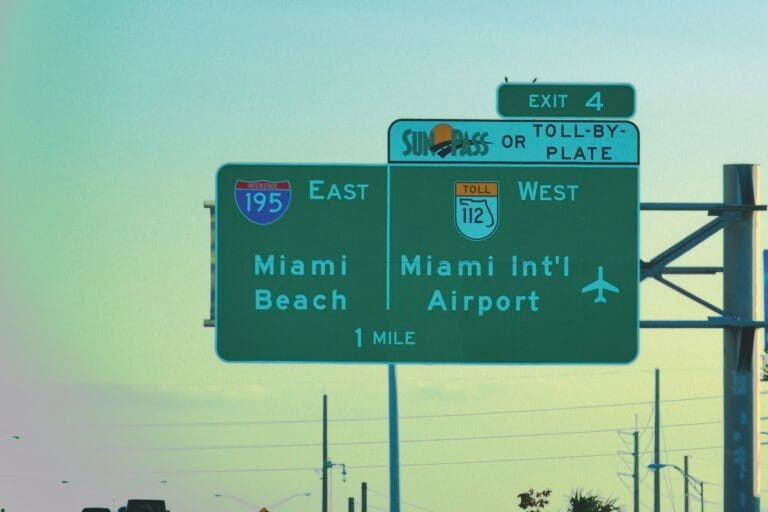
For decades, Miami has served as the commercial heartbeat linking the Americas. Today, as tariff disputes reshape trade flows, supply chains undergo major restructuring, and nearshoring accelerates, Miami International Airport is now well in command for hemispheric airfreight.
Setting records, moving volume
MIA handles roughly 70 percent of Florida’s airfreight and ranks among the top US cargo airports. In 2024, the airport processed roughly three million tonnes, a fifth straight record year. International cargo accounts for the vast majority of MIA’s throughput, with well over 2.5 million tonnes crossing borders annually at current volumes.
MIA is ranked first in the US for international freight and among the top ten global airports for cargo. MIA’s cargo operations generated US$181.4 billion in statewide business revenue in 2024 and supported approximately 843,000 jobs across Florida, according to an economic impact study by Martin Associates. The airport hosts more than 35 all-cargo carriers.
A perishables pipeline
Miami’s dominance in perishables is unmatched. Roughly 90 percent of US Valentine’s flowers come through MIA, US.Customs and Border Protection reported approximately 940 million stems processed at MIA for Valentine’s 2025 alone. Beyond the holiday, MIA handles about 90 percent of all US flower imports by air. Flowers are consistently MIA’s largest import commodity by weight, valued at more than US$1.6 billion annually.
MIA operates the nation’s most extensive US air links to Latin America, especially Colombia and Ecuador—the top two flower sources to the US by value. Chilean seafood, Ecuadorian fruit, Colombian flowers—if it’s fresh and the clock is ticking, it routes through Miami’s temperature-controlled facilities.
Pharmaceutical and digital commerce
In 2015, MIA became the first US airport designated by IATA as a Pharma Hub under the CEIV Pharma program, anchoring stringent cold-chain flows from Colombia, Brazil, and Puerto Rico. Multiple MIA community partners, airlines, forwarders, and handlers, have since earned CEIV certification.
e-commerce is another growth engine. Integrators like DHL, UPS, and FedEx have expanded Miami operations significantly. LATAM Cargo and Avianca Cargo keep adding capacity and new links, increasing freighter frequencies to serve growing cross-border e-commerce demand.
Investing in cargo infrastructure
Miami-Dade County has committed US$9 billion to MIA modernisation, with major cargo focus. The headline project: a nearly 800,000 sq ft Vertically Integrated Cargo Community facility, scheduled for completion in 2029. The VICC is designed to lift total cargo capacity by at least 50 percent, adding up to two million tonnes, and bring MIA’s capacity to at least 4.5 million tonnes, potentially reaching five million.
Competitive positioning
Miami is North America’s main hub for Latin America and the Caribbean, giving it a structural edge as Asia-US trade faces tariff uncertainty. MIA’s decades-deep carrier relationships, bilingual workforce, and cold-chain density would be a tall task to replicate. Shorter stage lengths to Latin America further improve operator economics. MIA ranks number one in US international freight and third for total cargo among US airports.
Constraints however do exist. Land is tight, making expansion costly. Customs processing can be a squeeze during peak periods. Noise and emissions draw growing scrutiny.
The nearshoring advantage
Nearshoring to Mexico, pharma growth in Puerto Rico and Colombia, and surging Brazilian e-commerce increasingly channel through MIA’s airfreight infrastructure. With proven expertise in perishables, pharma, and time-definite e-commerce, MIA is well positioned to capture the next leg of hemispheric cargo growth.
“Magic City” momentum
Miami has evolved from America’s gateway to Latin America into the Americas’ gateway to global markets. And with nearshoring, pharma booms, and e-commerce surging, the best tonnage is yet to come.