
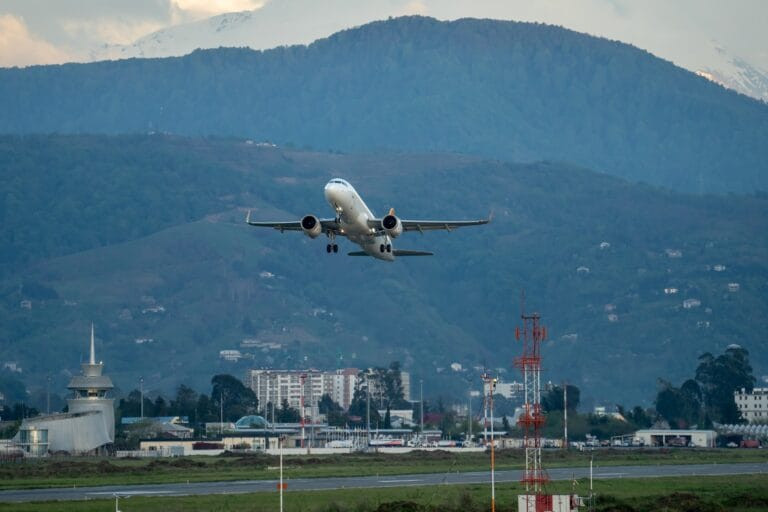
- Georgia’s success as a Eurasian transit corridor has strengthened road and rail to the point that air freight is losing share, shifting from a default solution to a niche, premium option as surface routes become more reliable and cost-effective.
- Passenger aviation is growing, but cargo is highly elastic and increasingly concentrated in urgent, high-value, or time-critical shipments, while mass flows—including much of e-commerce—migrate to predictable, lower-cost ground transport.
- This reflects logistics maturity rather than failure: to stay relevant, Georgia’s air cargo sector must deliberately position itself around non-substitutable segments (life sciences, express, critical spares), acting as the corridor’s premium layer rather than competing with rail and road.
Georgia has spent the past few years pitching itself as a strategic bridge between Europe and Asia: a compact transit state positioned to benefit from shifts in Eurasian supply chains. The “Middle Corridor” narrative, supported by rising interest in alternatives to traditional east–west routes, has helped Tbilisi build visibility far beyond its economic weight. What is less visible, but increasingly relevant for the air cargo sector, is that much of this growth is being absorbed by road and rail. As corridor performance improves, air freight in Georgia is struggling to keep pace and, in some segments, is becoming a secondary option rather than a driver.
From a market analysis perspective, this divergence is not just a Georgian data point. It illustrates how corridor economics evolve once supply chains stabilise. In early phases, aviation often acts as the release valve for unreliable infrastructure. As multimodal routes mature, that role changes. Air freight shifts from default solution to premium tool, used selectively and priced accordingly. Without a clear operational advantage, it becomes vulnerable to substitution.
Airport growth continues, but cargo follows a different curve
Georgia’s aviation sector continues to expand from a passenger standpoint. Airports handled approximately 7.45 million passengers in 2024, a figure that reflects broader connectivity and expanding airline networks. In theory, that growth should support cargo through increased belly capacity. In practice, belly availability only creates potential uplift. Shippers will use it only when cost, speed and reliability align.
Cargo is far more elastic than passenger traffic. It migrates quickly to the mode that best fits a shipper’s total cost and risk equation. In Georgia, that equation is being reshaped by improvements in rail scheduling, better corridor coordination, and trucking networks that benefit from the country’s role as a transit state rather than an origin-destination market. As a result, air freight is increasingly concentrated in consignments where delay carries disproportionate cost: urgent healthcare shipments, AOG components, high-value electronics, or genuinely time-critical perishables.
This is the core dynamic of corridor economies. Airports may grow, airlines may add routes, and trade volumes may rise, but cargo will not automatically flow by air once surface options become sufficiently reliable.
Why road and rail are gaining share: the predictability premium
Georgia’s corridor strategy has prioritised throughput and reliability. Investment has focused on rail, road, border processes and transit coordination, and the effects are now visible in how forwarders design networks. As schedules become more predictable, surface routings become easier to plan around, even if they remain slower than air.
The shift is gradual but structural. Early corridor development is typically marked by volatility: uneven customs performance, inconsistent handovers and uncertain transit times. In that environment, air freight absorbs disruption. As coordination improves, predictability begins to outweigh speed. Once that threshold is crossed, aviation loses share unless it can defend a clearly differentiated role.
In Georgia’s case, three factors are shaping this transition.
First, the cost gap is widening. Rail and road rarely compete with air on transit time, but they do so decisively on unit economics. For retail, consumer electronics and other margin-sensitive flows, transport cost becomes a strategic variable rather than a secondary consideration.
Second, delivery confidence increasingly outweighs headline velocity. A shipment that reliably arrives in four days with low variance can be commercially superior to one that could arrive next day but carries a higher risk of exception, congestion or documentation delay. Reliability is not only operational; it is contractual.
Third, corridor investment naturally advantages surface modes. Rail terminals, road upgrades and trade facilitation reforms create systemic benefits that compound over time. Airports can modernise as well, but unless air freight is deliberately positioned, the corridor’s default layer becomes ground-based.
The e-commerce paradox: growth without uplift
e-commerce is often cited as a guaranteed catalyst for air cargo demand. Georgia demonstrates why that assumption only holds under specific conditions.
Much of the cross-border e-commerce associated with Chinese platforms follows a cost-optimised model at scale. Air freight is typically used in early market phases, when volumes are uncertain and delivery expectations are still forming. As flows stabilise, consolidation increases, urgency decreases, and logistics design shifts toward modes that compress cost per parcel.
That progression often moves from urgent uplift to consolidated uplift, and then to surface routing wherever lead times allow. Georgia can therefore gain relevance as an e-commerce transit corridor without seeing a corresponding increase in air cargo tonnage. Value accrues to rail and road, while aviation is left handling premium exceptions rather than mass flows.
In this context, the corridor is winning even if the airport is not.
What this means for freighter operations
For freighter operators, this environment has direct commercial consequences. Markets dominated by belly capacity are difficult to sustain as freighter destinations unless they offer either stable high-yield traffic or cargo segments that cannot be substituted by surface transport.
As volumes soften or become inconsistent, freighter economics deteriorate quickly. Utilisation drops, network planning becomes fragile, and services shift toward seasonal, charter-led or opportunistic operations. Over time, the market risks being reclassified from an emerging node to a feeder point, served when conditions align rather than embedded into regular rotations.
Cargo volatility also alters shipper behaviour. When schedules become uncertain, forwarders consolidate volumes elsewhere. Warehousing decisions follow. Contracts are renegotiated. Gradually, the market re-anchors around hubs that offer redundancy and consistency, even if they are not faster.
The strategic question
Georgia’s corridor success is real, but it brings a trade-off. As ground logistics strengthens, air freight risks being marginalised unless it is repositioned as a deliberate strategic layer of the national logistics model.
The opportunity is not to reclaim general cargo from rail and road. That battle is largely unwinnable on economics. The opportunity lies in building an air cargo ecosystem that dominates high-value, high-reliability segments: life sciences, express, critical spare parts, and specialist temperature-controlled flows. That requires more than warehouse capacity. It requires predictable cut-offs, fast and consistent customs performance, secure screening throughput, and cold-chain integrity that minimises exception risk.
In corridor economies, airports do not compete with rail yards. They succeed by becoming indispensable for cargo the corridor cannot move well.
Georgia’s air cargo slowdown is therefore less a sign of failure than an indicator of logistics maturity. Mass flows are shifting to wheels and rails, as corridors are designed to do. The challenge for Georgian aviation is to ensure air freight is not diluted by that success, but elevated by it — as the premium layer that sustains trade when corridors become congested, disrupted, or politically uncertain.