
- Cold chain integrity relies on more than packaging; trained staff, reliable facilities, proper procedures, and end-to-end visibility are all essential to ensure temperature-sensitive pharmaceuticals arrive safely.
- Each shipment faces multiple critical control points and trade lane-specific risks, making contingency planning, backup providers, and route flexibility as important as the packaging itself.
- Innovation and sustainability in thermal packaging are increasingly important, but speed, availability, and reliability remain paramount in protecting life-saving products throughout complex supply chains.
When it comes to moving time- and temperature-sensitive pharmaceuticals, the integrity of cold chain shipments depends on much more than the packaging itself.
“One can choose a packaging solution, but if you give it to someone who doesn’t have the right trained staff to handle it, the right facility, the right processes in place, and the right airline, you are naturally asking for trouble at the end of the day,” Bourji Mourad, Director of Global Leasing and Market Development at Sonoco ThermoSafe, explained.
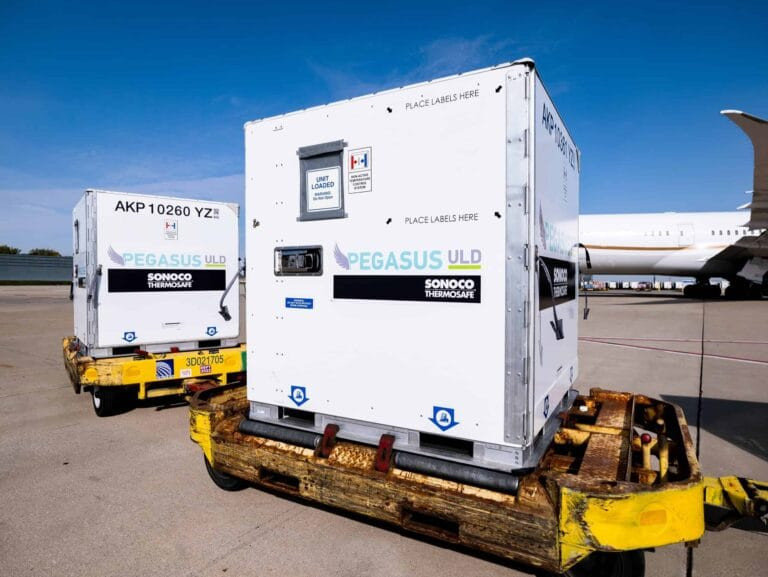
Thermal packaging is critical, but it cannot always compensate for weaknesses elsewhere in the supply chain. “People often focus on the temperature-control container (TCC), for example, thinking it’s going to protect the product under all circumstances. That’s a misconception,” Mourad says. “A TCC alone cannot account for trade lane variability, storage conditions at intermediate hubs, or delays due to customs clearance. It’s the combination of correct packaging, processes, facilities, visibility, and people that ensures life-saving products arrive safely.”
Critical control points
Every shipment faces unique challenges depending on its trade lane, temperature-sensitive product, packaging, and airline used. “Not every trade lane is the same. Shipping from the northern hemisphere to the southern hemisphere, the temperature ranges are different. You have areas where destinations could take much longer to clear cargo. If we’re shipping to some of the airports in South America, for example, it could take a lot longer than airports in other countries to release pharmaceutical products,” he says.
Delays can mean that even the best packaging is left vulnerable during storage or transport, exposing sensitive medicines to potential temperature excursions.
There are multiple touch points where temperature deviations can occur. “You talk in an excess of ten critical control points from door to door. Then there’s the last mile from the distribution centre or consignee to the clinic or patient. There are so many other critical control points as well,” Mourad adds. Every stage requires trained personnel, regularly calibrated equipment, and proper procedures.
“Even if your packaging is perfect, without the correct handling and visibility at these points, the time- and temperature-sensitive product is at risk.”
Trade lane complexity also affects contingency planning. “Some hubs are extremely efficient, others are less so. Even minor delays can compound if the staff are untrained or procedures are inconsistent. This is why risk analysis must precede the selection of packaging solutions. It’s not just about what packaging keeps the product at a certain temperature — it’s about the entire journey,” Mourad says.
Contingency management
One lesson highlighted during the pandemic was the importance of redundancy in the supply chain. “Once a pharma company has qualified a packaging solution, it’s a long-winded process to qualify another. If they didn’t have a backup plan, what happens when there aren’t enough TCCs or similar packaging available at a particular location?” Mourad says.
“Even if you have the perfect packaging at origin, if the destination or transit doesn’t have the right facilities, everything can go wrong. That’s why you must look into trade lane risk analysis before committing to a packaging solution or provider,” he explains. Backup plans, multiple providers, and alternative logistics routes are now as critical as the container itself.
Mourad adds that collaboration across the supply chain has also become essential. “During COVID, forwarders shared aircraft capacity, and airlines removed seats to carry cargo on upper decks. Cooperation was key. Without that level of planning and flexibility, many shipments would have failed,” he notes.
Sustainability and innovation
Packaging providers are under increasing pressure to balance thermal performance with sustainability. Mourad explains, “We are very much into the innovation side of things. We’re working on materials that are lighter, more sustainable, with longer thermal performance. In addition to bulk reusable Temperature Control Containers, we’ve introduced reusable parcel-size thermal packaging under a rental model alongside our single-use packaging solutions.”
While sustainability is a growing priority, pharmaceutical companies often must weigh it against speed and availability. “Sometimes the most sustainable option isn’t available everywhere. In those cases, reliability and speed take precedence,” he says. Still, innovation is a key differentiator in the market, improving both environmental outcomes and the ability to maintain consistent temperatures.
For Mourad, the overarching message is clear: thermal packaging and Temperature Control Containers are necessary, but they are not sufficient on their own. Successful cold chain logistics require trained staff, careful planning, backup strategies, and ongoing innovation. “Packaging is a critical piece, but it’s just one element. Without trained personnel, standard operating procedures, partnering with approved providers, contingency planning, and trade lane awareness, even the most advanced packaging cannot guarantee the integrity of life-saving products in transit,” he concludes.