
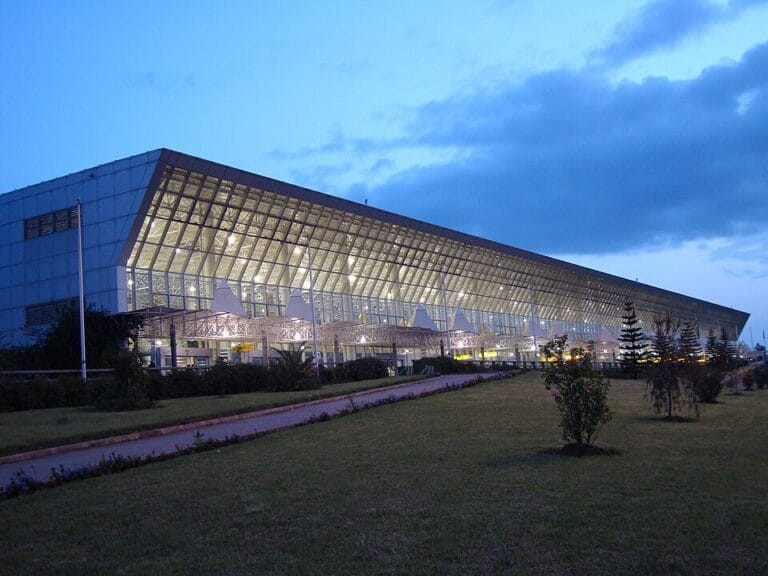
- Addis Ababa Bole International Airport has emerged as one of Africa’s most important airfreight hubs, driven by Ethiopian Airlines Cargo & Logistics Services. The airport specialises in time-critical and temperature-sensitive cargo, handling flowers, pharmaceuticals, electronics and e-commerce shipments, supported by advanced cold storage and digital systems.
- Bole benefits from a central geographic position between Europe, Asia and Africa, making it ideal for pan-African consolidation and global distribution. Its model prioritises speed and reliability for high-value, low-weight goods, aligning with rising intra-African trade under AfCFTA and global shippers seeking alternatives to congested routes.
- Challenges include capacity constraints, apron congestion, landside access, and competition from Nairobi, Johannesburg and Lagos. Continued growth depends on expansion, efficient customs, regulatory support and surface transport improvements. With the right investments and operational discipline, Bole is poised to strengthen its role as Africa’s leading airfreight gateway and a key node in global logistics.
In the fast-evolving world of global logistics, few African assets punch above their weight quite like Addis Ababa Bole International Airport. Long recognised as the beating heart of Ethiopian Airlines’ passenger network, Bole has, more quietly and more strategically, become one of the continent’s most important airfreight gateways. Today, as Africa’s trade ambitions collide with supply chain disruption, e-commerce growth and the demands of high-value cargo, Bole finds itself at a pivotal moment.
At the centre of Bole’s airfreight significance is Ethiopian Airlines Cargo & Logistics Services, now one of the largest cargo operators in Africa and a serious global contender. The airline’s cargo arm has invested heavily in freighters, cold-chain infrastructure and digital systems, allowing Addis Ababa to function not merely as a national gateway but as a pan-African consolidation hub. Flowers from Kenya, seafood from West Africa and pharmaceuticals bound for Southern Africa increasingly pass through Bole’s warehouses en route to global markets.
The timing is no accident. The African Continental Free Trade Area (AfCFTA) has sharpened focus on intra-African trade, while global shippers are actively seeking alternatives to congested and geopolitically sensitive routes. Addis Ababa’s geographic position – roughly equidistant between Europe, Asia and much of Africa – gives it a natural advantage. In airfreight terms, it is close enough to everything to matter.
Yet the real story at Bole today is not geography; it is specialisation. The airport has positioned itself as Africa’s leading hub for time-critical and temperature-sensitive cargo. Its purpose-built cold storage facilities are among the most advanced on the continent, supporting Ethiopia’s vast flower export industry as well as a growing volume of pharmaceuticals and vaccines. During the COVID-19 pandemic, Bole proved its mettle by handling unprecedented volumes of medical supplies, reinforcing its reputation as a reliable node in global health logistics.
This capability aligns neatly with broader shifts in airfreight demand. While general cargo remains important, growth is increasingly concentrated in high-value, low-weight goods: pharmaceuticals, electronics, express parcels and e-commerce shipments. African consumers are buying online in greater numbers, and African producers are selling directly to global buyers. For these flows, speed and reliability matter far more than marginal cost savings. Bole’s model is built precisely for this reality.
However, success brings its own pressures. Capacity constraints are becoming harder to ignore. Bole is already one of Africa’s busiest airports, handling significant passenger traffic alongside its growing cargo volumes. Apron congestion, slot availability and landside access are increasingly sensitive issues. While plans for expansion and a new mega-airport outside Addis Ababa have been discussed for years, timelines remain uncertain, and the current airport must carry the load in the meantime.
There is also the question of competition. Other African airfreight airports are sharpening their claws. Nairobi’s Jomo Kenyatta International Airport continues to invest in cargo facilities, particularly for perishables. Johannesburg’s OR Tambo remains a heavyweight for Southern Africa. In West Africa, Lagos is pushing to modernise its cargo infrastructure. Bole’s advantage is real, but it is not unassailable.
Another challenge lies beyond the perimeter fence. Airfreight does not thrive in isolation; it depends on efficient customs, predictable regulation and reliable surface transport. Ethiopia has made strides in customs modernisation and trade facilitation, but further improvements will be essential if Addis Ababa is to maintain its edge as volumes rise. Delays on the ground can undo the value of speed in the air, a lesson well understood by global shippers.
Looking ahead, the strategic importance of Addis Ababa Bole International Airport to African airfreight is unlikely to diminish. If anything, it will grow. As supply chains regionalise, as AfCFTA begins to move goods rather than merely paper, and as African producers climb the value ladder, demand for sophisticated air cargo hubs will intensify. Bole is well placed to remain at the forefront of this transformation.
The question is not whether Addis Ababa will continue to matter, but whether it can evolve fast enough to stay ahead. With the right investments, policy support and operational discipline, Bole could cement its status not just as Africa’s leading airfreight airport, but as one of the world’s most influential logistics crossroads. In the high-stakes game of global cargo, that would be a prize worth holding.