
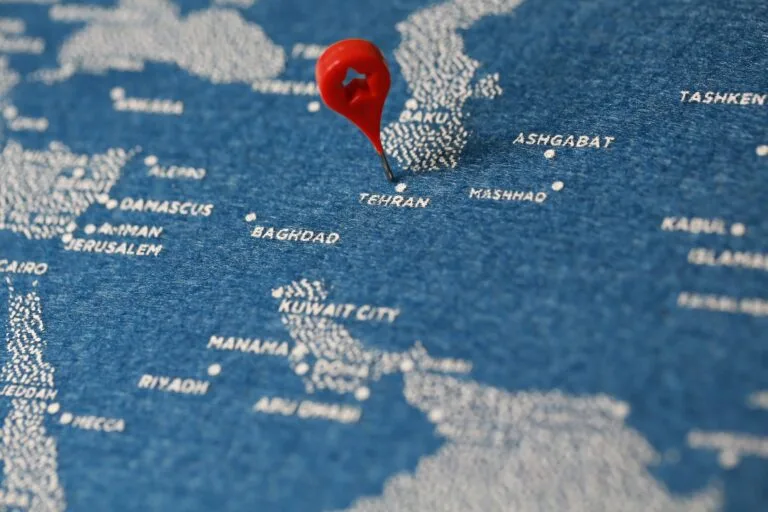
- Iran’s renewed instability is turning airspace access into a supply-chain risk variable, forcing Indian and eastern hemisphere shippers to rethink routings, cut-offs and inventory buffers for Tehran-bound freight.
- Perishables and pharmaceuticals are the most exposed cargo categories, as even short airspace disruptions can trigger missed market windows and cold-chain stress.
- India’s cargo continuity play is increasingly “multi-lane” mixing direct belly capacity with diversion via Gulf hubs and rapid ground feeders to alternative gateways.
Air cargo rarely features in public debate until it becomes disrupted. But for trade-dependent sectors such as fresh produce, pharmaceuticals and other time-critical commodities, the stability of air corridors is increasingly as important as capacity itself. India’s air logistics links that transit Iranian airspace illustrate this shift clearly: when a route becomes unpredictable, supply chains do not merely slow. They reprice, reroute and, in some cases, reorganise permanently.
That vulnerability was highlighted again on 15 January 2026, when Iran’s airspace was closed at short notice for a defined time window, with only limited flight categories allowed. While the closure itself was brief, its signalling effect matters far more than its duration. For airlines, freight forwarders and exporters, it reinforces an operational reality: transit routes that pass through or depend on Iranian airspace can shift from routine to constrained with little warning. Cargo planners are therefore increasingly forced to treat the region as a managed-risk operating environment.
For India’s air cargo sector, especially the perishables trade, this is no longer an occasional disruption scenario. It is becoming a repeatable planning variable.
Why perishables turn route instability into commercial risk
Perishables respond to disruption differently from general cargo because time is not simply a service metric; it is a quality determinant. A shipment of fresh fruit delayed by even a few hours can lose shelf life, downgrade in grade, or miss its ideal sales window. The economic impact is often non-linear. Initial delays may be absorbed, but once temperature exposure, additional handling and missed uplift accumulate, commercial impairment can occur rapidly.
This is why perishables magnify volatility in transit routes. Exporters and importers in this category increasingly prioritise predictability over theoretical speed, and many are willing to pay a premium for reliability if it protects quality. In parallel, air freight’s strategic importance remains disproportionate to its share of cargo volume. While air cargo accounts for only a small share of global trade by weight, it represents a significant portion of trade value, often cited at around one-third, because it carries the highest-value and most time-sensitive commodities.
Put simply, route instability is not just an airline issue. It is a trade competitiveness issue.
From routes to resilience
The most important change is behavioural. In earlier decades, disruptions were treated as exceptions and managed case by case. Today, volatility is frequent enough that networks are increasingly engineered with built-in contingency. For India’s cargo ecosystem, the response is coalescing around three resilience mechanisms.
The first is flexible uplift management. Forwarders allocate capacity dynamically rather than committing perishables to fixed routings. Higher-risk shipments, those with shorter shelf life or tighter market timing, are prioritised for earliest and most reliable uplift. Lower-risk cargo may be held for later departures if quality economics allow. The objective is not delay, but the avoidance of “wasted uplift”, where cargo arrives too late to realise its intended value.
The second mechanism is modal substitution and hybrid routing. Perishables have limited flexibility, but other export categories such as textiles, consumer goods and selected industrial inputs can temporarily shift via sea–air combinations or alternate overland options. This relieves pressure on constrained air capacity, allowing scarce uplift to be reserved for perishables and urgent medical cargo when routes tighten.
The third mechanism is inventory positioning. Larger exporters and importers increasingly place buffer stock in intermediary distribution nodes, often Gulf-linked logistics hubs, so downstream commitments can still be met even if origin-to-destination transport becomes unstable. This functions as supply-chain insurance: a modest additional cost that reduces the probability of contractual failure.
Together, these adjustments reflect a wider evolution. Air cargo is no longer being optimised solely for cost and speed. It is increasingly being optimised for continuity.
Operational response to geopolitical disruption
Even short-notice airspace restrictions trigger rapid re-optimisation across flight planning, ground handling and customer commitments. For air cargo operators, several effects are immediate.
The first is rerouting. Avoiding constrained flight information regions adds distance and fuel burn, while also increasing crew-hour exposure. A less visible consequence is schedule deformation. Arrival times shift, and freighters that once landed within optimal cargo-handling windows may now arrive during periods of peak congestion. For airports, this creates bunching effects that raise dwell time and undermine the reliability exporters pay for.
The second effect is a stronger preference for schedule integrity over frequency. Under sustained volatility, airlines are less inclined to add capacity and more focused on protecting performance. In perishables markets, reliability can outweigh nominal uplift availability. Shippers may accept fewer departures if those flights operate consistently.
The third adjustment is hub substitution. Cargo may be consolidated through hubs with greater redundancy and service stability, where onward uplift options are broader. While this can preserve continuity, it introduces additional handling steps such as screening, offload and reload. Each touchpoint increases risk for perishables, so hub substitution is treated as a deliberate trade-off rather than a default solution.
Why elasticity behaves differently
Perishables demand is often described as inelastic because the product must move. Operationally, this is true at the point where the commodity cannot wait indefinitely. Economically, however, perishables demand is fragile. If disruption pushes total logistics costs beyond the commodity’s margin structure, exporters may ship less, divert volumes to alternative markets, or absorb value erosion.
This is where transit-route volatility becomes a structural competitive factor. The first-order effect is cost transfer, with higher freight, fuel and handling costs absorbed somewhere along the chain by exporters, importers or consumers. The deeper risk lies in the second-order effect: smaller exporters and growers lose viability because they cannot secure premium uplift or withstand pricing volatility. Over time, market participation consolidates around larger shippers with stronger cold-chain controls, contractual airline allocations and diversified routing options.
In practical terms, route disruption does not merely delay cargo. It reshapes who can participate in trade.
Routes are now as important as airportsOver the past two decades, India has invested heavily in airport cargo infrastructure, including terminal expansion, cold-chain upgrades, screening capacity and digitisation. These investments remain essential. However, volatility linked to Iranian airspace highlights a newer reality: airport capability alone cannot offset instability in the routes that connect them.
As route risk rises, exporters demand tighter cold-chain integrity at origin. Shippers diversify across carriers. Insurers and compliance teams apply higher risk pricing and stricter documentation thresholds. Cargo ecosystems that perform well under pressure, through predictable cut-offs, rapid transfers and disciplined handling, become more attractive.
This is where route resilience turns into market advantage. The most competitive air cargo systems are those that remain predictable even when the map becomes uncertain.
Volatility is accelerating supply-chain hardening
The key question is not whether India–Iran air cargo flows stop. The more relevant issue is how quickly operators move from ad hoc mitigation to structured resilience.
The Tehran airspace closure in January 2026 is best read as a reminder that air cargo does not operate on infrastructure alone. It depends on political and security conditions that sit beyond airport fences and airline balance sheets.
For India, protecting perishables demand is therefore no longer only an export-growth challenge. It is increasingly a route-continuity challenge that requires airlines, forwarders, exporters and policymakers to treat contingency planning as part of trade infrastructure. If managed well, India’s competitive edge in the next phase of air logistics growth will be defined not only by capacity, but by dependability under stress.

