
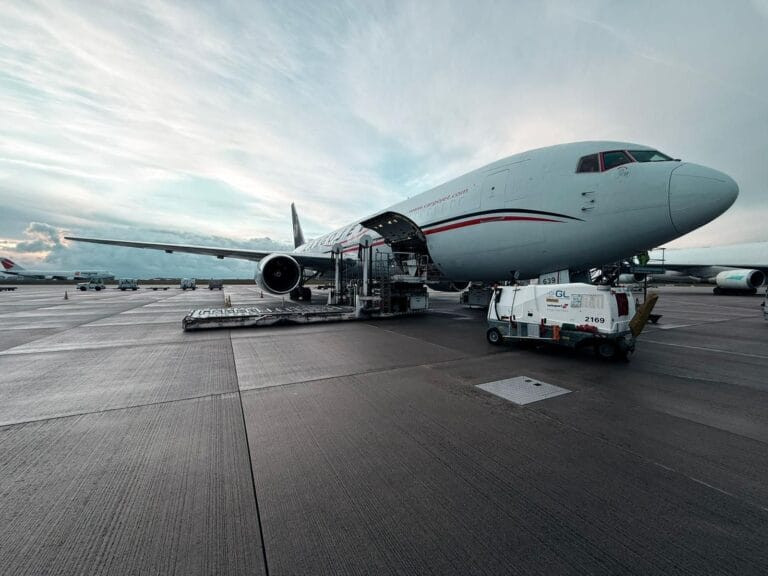
- Festive-season demand drove a surge in live lobster airfreight through Liege Airport, with four dedicated flights from Halifax delivering about 160 tonnes over two holiday weekends.
- Swissport played a central role by coordinating pre-arrival planning, rapid airside transfer, and immediate inspection to maintain strict temperature control and regulatory compliance.
- Strong consumer demand and effective peak-period planning underscore live lobsters as a resilient, high-value air cargo flow, where timing, staffing, and coordination are critical to success.
As the festive season drives up demand for fresh seafood across Europe, Liege Airport has once again seen a sharp uptick in live lobster shipments – with Swissport playing a key role in the high-stakes operation to keep the product alive and compliant under tight time constraints.
Over two holiday weekends, four dedicated flights arrived at Liege carrying a combined total of approximately 160 tonnes of live lobsters. The uplift included two regular weekly shipments and two additional flights scheduled to meet seasonal demand. Each aircraft carried around 40 tonnes of cargo originating from Halifax, Canada.
“Lobster shipments arrive at LGG on a weekly basis throughout the year. During the holiday season, one additional flight per week was scheduled over a two-week period. This means that over the two holiday weekends, a total of four flights arrived — two regular weekly flights and two additional flights. Each flight carries approximately 40 tonnes of lobsters, resulting in a combined total of around 160 tonnes delivered over the period. ”
Timing and temperature control are everything when transporting live animals by air. At Liege, Swissport handles the airside transfer and immediate movement to inspection.
“On arrival, lobster shipments are transferred directly from the aircraft to the airport inspection centre for immediate breakdown and checks,” said Dirk Goovaerts, CEO Continental Europe, Middle East, Africa, India & Global Cargo Chair at Swissport. “This efficient process minimises time outside temperature-controlled environments and helps protect product integrity and compliance requirements.”
Coordination begins even before the aircraft touches down. According to Goovaerts, “Cargojet provides a pre-alert at departure, which allows our airside team and the airport inspection centre to prepare in advance. This early coordination ensures the shipment can move directly from aircraft to inspection with minimal delay.”
While full data for this season isn’t yet available, Swissport expects lobster volumes to remain strong. “Market data indicates that volumes of lobsters transported by air into Europe remain robust, with predictable seasonal peaks around key festive periods,” Goovaerts said.
He pointed to continued consumer appetite and the critical role of airfreight in moving high-value, temperature-sensitive seafood across continents. “Market fundamentals point to lobsters remaining a resilient and important air cargo flow during peak periods.”
Managing live animals during seasonal peaks adds layers of complexity to ground operations. Staffing, speed and regulatory handling must all be tightly choreographed.
“Planning and people make the difference,” Goovaerts said. “Peak periods require precise resource allocation, with sufficient staffing and inspection capacity in place so shipments can be processed immediately on arrival.”