
WorldACD: March growth not seen since 2009/10

WorldACD: March growth not seen since 2009/10

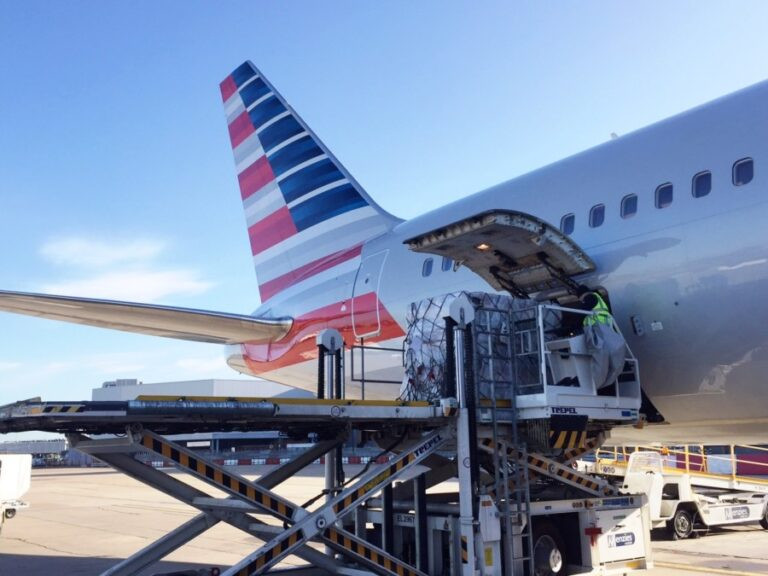
An American Airlines Boeing 767 gets loaded at Heathrow Airport

The month of March will be remembered in air cargo for a year-on-year (YOY) percentage growth not seen since the recovery years 2009/2010, according to the latest report by WorldACD Market Data.

The worldwide YOY numbers impressive the market analyst says “by any standard” and included a 14.6 per cent increase in chargeable weight (origins Asia Pacific and Europe +19 per cent).

There was also a 16.4 per cent rise in direct ton kilometres – the measure combining weight with the geographical distance between origin and destination of shipments.

But World ACD says the first 100 days of US President Donald Trump didn’t lead to an uptick in air cargo for US carriers, who it says as a group were well “way behind all other regional carrier groups”.

However, for all carriers together, revenues (in USD) from air cargo destined for the US grew stronger than for any other destination region (+14.7 per cent against +8.5 per cent worldwide), but revenues from the US showed the opposite trend – +2.3 per cent versus +8.5 per cent worldwide. Revenues from domestic US dropped by 2.9 per cent.

World ACD says business was particularly upbeat from Hong Kong, Shanghai, Beijing, Guangzhou, London, Milano, Frankfurt and Chicago, which all had a growth of more than 20 per cent.

The analyst says it expects April will be another very good month, but – in view also of the Easter-effect – YOY growth may stop around 10 per cent.

And it notes airlines must have been pleased with a worldwide USD-yield improvement of 5.1 per cent month-on-month. The origin area Asia Pacific showed the highest growth (+11.9 per cent), but this area was also the only one with a yield drop for all incoming traffic (-0.7 per cent). The yield index for eight of the ten largest region-to-region markets went up as well.

World ACD says carriers from Asia Pacific and the Middle East recorded the largest overall YOY growth with 12 per cent, and nine per cent, respectively.

Their colleagues from the Americas grew more than their Asian and European competitors in non-general cargo. The Americans showed strong YOY growth in dangerous goods (DGR), pharmaceuticals (PIL) and vulnerable cargo, albeit from a small base.

The five African carriers in the analyst’s database, although not necessarily representative for Africa as a whole, almost doubled their carriage of DGR and grew 40 per cent in PIL, but again: from a low base.

In perishables, African carriers attained the highest growth percentage of all. The Europeans remain far ahead in total tonnes carried in PIL and DGR: their percentage growth may have been lower, but they still added an impressive 10 per cent and 11 per cent, respectively to their volumes.


Picture of James Graham

James Graham

James Graham is an award-winning transport media journalist with a long background in the commercial freight sector, including commercial aviation and the aviation supply chain. He was the initial Air Cargo Week journalist and retuned later for a stint as editor. He continues his association as editor of the monthly supplements. He has reported for the newspaper from global locations as well as the UK.

subscribe to acw for free
stay informed. stay ahead

To get the latest air cargo news and industry trends delivered directly to your inbox, subscribe now!

Newsletter

Stay informed. Stay ahead. To get the latest air cargo news and industry trends delivered directly to your inbox, sign up now!

related articles

Air travel in Southeast Asia is growing at a rate well above the global average. This has prompted the development of a new airport to serve as Cambodia’s new capital gateway. Cambodia has responded with Techo International Airport (KTI) – a landmark project by Cambodia Airport Investment Co. Ltd. (CAIC), a subsidiary of Overseas Cambodian Investment Corporation, in partnership with the State Secretariat of Civil Aviation (SSCA) – bringing world-class infrastructure and next-generation airport systems to the country’s new capital gateway. Replacing the former Phnom Penh International Airport, Techo International Airport opened on 9 September 2025 and represents the centrepiece of Cambodia’s aviation strategy. The airport is classified as a “4F-class” airport – meaning it can accommodate the largest cargo and passenger aircraft, such as Airbus A380 and Boeing 747, which allows large-scale cargo operations. According to plans, in its first phase the airport is expected to handle up to 175,000 tonnes of air cargo per year. Early official data cited indicates that the airport is designed for around 26,000 tonnes of cargo annually under initial operations. The large cargo-handling capacity (175,000 t/year) is significantly higher than the early-operation figure (26,000 t/year), which suggests the airport will scale up cargo operations as traffic increases. The airport’s infrastructure (runway, terminals, large-aircraft capability) positions it to support major international freight, enabling imports and exports of goods such as garments, agricultural products, electronics, helping Cambodia increase trade volumes. With large-aircraft handling, Techo can link to long-haul cargo routes around the world. Operational cargo logistics at Techo The airport now has a dedicated cargo terminal. Working hours for cargo operations are listed as 08:00 to 00:00 (midnight), seven days a week, though with flexibility depending on flight schedules. Customs operations are generally Monday–Friday 07:00–17:30 (with Saturday half-day), but clearance outside those hours can be arranged by prior coordination. As the airport has just opened, the full ramp-up of freight may take time. So the cargo-handling capability, a maximum of 175,000 tonnes a year, is a target rather than yet-achieved throughput. To give a scale of the planned operation, Cambodia’s three international airports collectively carried 75,000 tonnes of air cargo in the first 10 months of 2025.

Shannon Airport Group begins €14m business park expansion

Growth transforms Billund Airport